Czech Republic Approves ViDA Implementation Legislation — What It Means for Businesses
On 10 September 2026, the Czech lower house (Poslanecká sněmovna) approved draft legislation implementing key elements of the EU's VAT in the Digital...

Infinite has been our IT systems provider since 2004. The implementation of EDI system automated the flow of documents (such as invoices and orders). The delivery of our products takes place faster now, while the cost of order processing is noticeably lower.
Tomasz Bekasiewicz
IT Manager
Your complete roadmap to mandatory e-invoicing compliance under the UAE Federal Tax Authority’s EmaraTax system.

4 min read
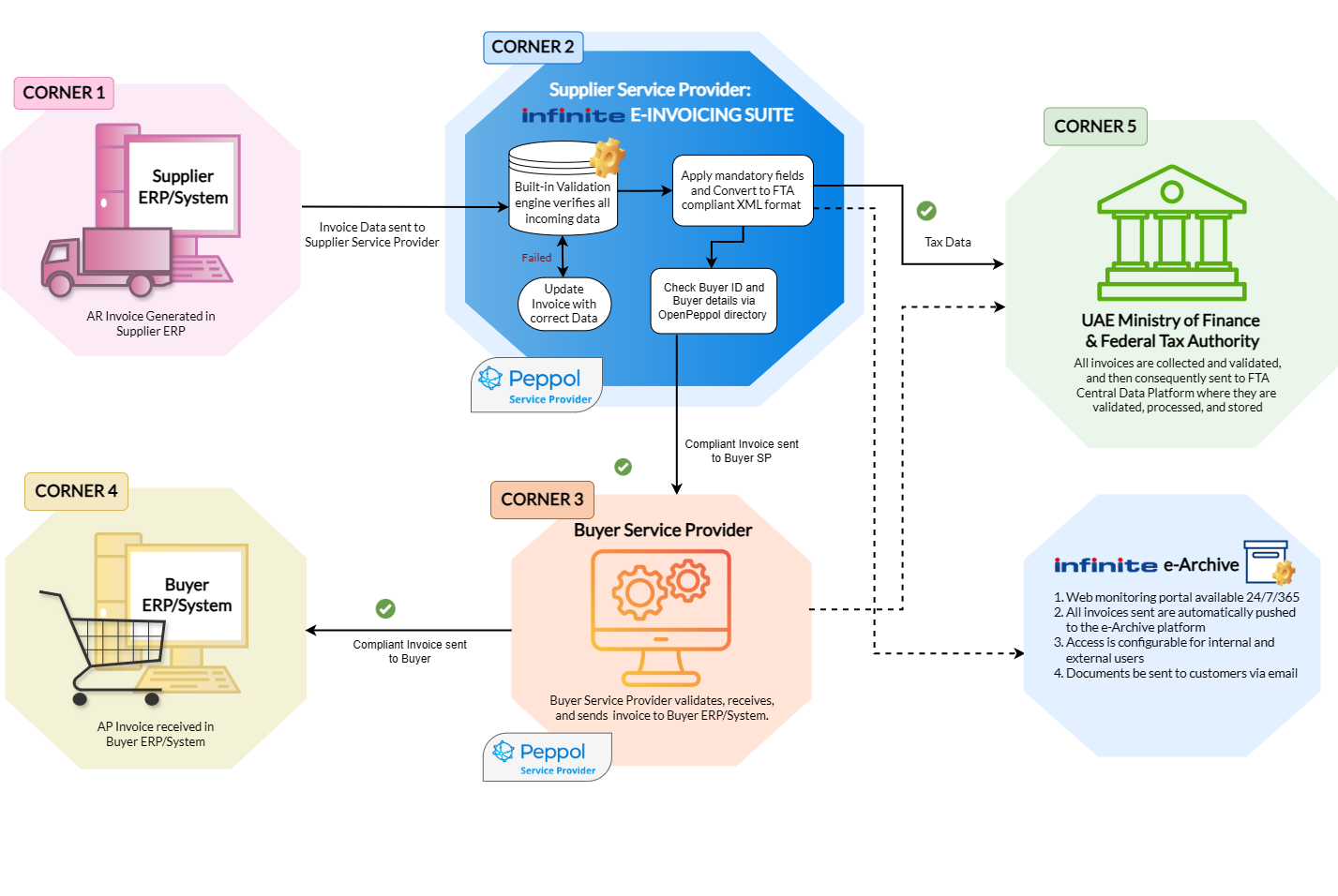
The UAE is moving towards a structured, automated e-invoicing framework based on the 5-corner model, also known as Decentralized Continuous Transaction Control and Exchange. This model changes how invoices are issued, validated, exchanged and reported between businesses, service providers and the tax authority.
For companies operating in the UAE, this is more than a technical change. It affects ERP systems, finance processes, tax reporting, supplier and buyer data, invoice validation and long-term compliance.
The 5-corner model is the architecture chosen for UAE e-invoicing. Instead of sending invoices directly from supplier to buyer, businesses exchange structured e-invoices through Accredited Service Providers, while tax data is reported to the UAE Ministry of Finance and Federal Tax Authority.
The five corners are:
Corner 1: Supplier
The business that issues the invoice, usually from an ERP, billing or accounting system.
Corner 2: Supplier’s Accredited Service Provider
The service provider that receives invoice data from the supplier, validates it and prepares it for compliant exchange.
Corner 3: Buyer’s Accredited Service Provider
The service provider that receives the invoice on behalf of the buyer and delivers it to the buyer’s system.
Corner 4: Buyer
The business that receives the invoice in its ERP, finance or AP system.
Corner 5: UAE Ministry of Finance and Federal Tax Authority
The government corner responsible for receiving tax data related to the invoice.
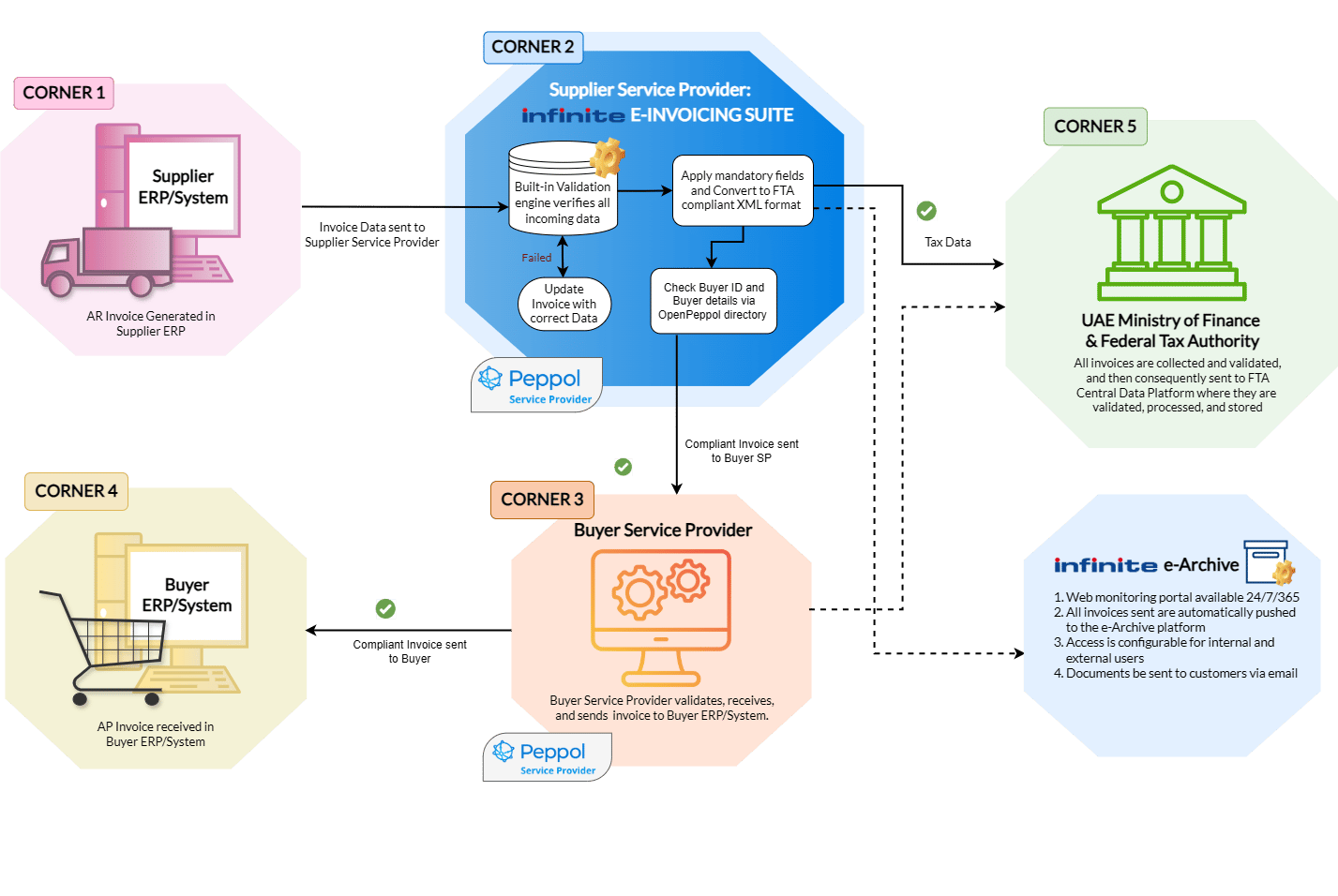
The 5-corner model is designed to support automation, interoperability and continuous tax reporting.
In a traditional invoicing process, companies often rely on PDFs, emails, manual uploads or disconnected systems. These formats are difficult to validate automatically and often create delays, errors and manual work.
In the UAE model, invoices are exchanged as structured electronic data. This allows systems to validate invoice fields, check routing details, exchange documents between trading partners and report tax data in a controlled way.
The goal is not only to replace paper or PDF invoices. The goal is to create a more reliable digital invoicing process between businesses, service providers and the tax authority.
The process starts when the supplier creates an invoice in its ERP or billing system.
The invoice data is sent to the supplier’s Accredited Service Provider, or ASP. This ASP validates the invoice data and converts it into the required UAE standard e-invoice XML format if needed. According to the UAE Ministry of Finance, the supplier’s service provider then transmits the e-invoice to the buyer’s UAE Accredited Service Provider and reports the tax data document to Corner 5.
The buyer’s ASP receives the invoice, performs its own checks and delivers the invoice to the buyer’s ERP, finance or accounts payable system.
As a result, the buyer receives a structured electronic invoice that can be processed automatically, rather than a static PDF attachment.
An Accredited Service Provider is the technical link between a company’s internal systems, the Peppol-based exchange network and the UAE tax reporting framework.
In practice, the ASP helps with:
This role is important because UAE e-invoicing is not only about generating an invoice file. It is about making sure the invoice can be validated, exchanged and reported in line with the official framework.
PINT-AE is the UAE implementation of the Peppol International Invoice standard. It defines how invoice data should be structured for electronic exchange in the UAE. The Ministry of Finance describes the supplier submitting e-invoice data in PINT-AE to its UAE Accredited Service Provider.
For businesses, this means invoice data from ERP, billing or accounting systems must be mapped to the required structure. Missing fields, incorrect identifiers or inconsistent tax data can cause validation issues before the invoice is exchanged.
That is why preparation should include more than choosing a technology provider. Companies also need to review data quality, invoice flows, master data, tax fields and integration readiness.
Corner 2 and Corner 3 are where much of the technical compliance work happens.
As Corner 2, the supplier’s ASP prepares the outgoing invoice. It validates the data, converts it into the UAE-compliant format and sends it to the buyer’s ASP.
As Corner 3, the buyer’s ASP receives the invoice, validates it and delivers it to the buyer’s internal system.
For companies with multiple ERPs, shared service centres, international entities or high invoice volumes, these two corners are critical. They determine whether invoice exchange is smooth, automated and scalable — or whether the business still depends on manual fixes and exception handling.
Businesses should start by mapping their current invoice process. This includes outgoing invoices, incoming invoices, credit notes, ERP integrations, buyer and supplier master data, tax identifiers and archiving requirements.
The next step is to assess whether invoice data can be converted into the required UAE format and exchanged through the ASP model.
A practical readiness plan should cover:
The earlier these areas are reviewed, the lower the risk of delays when mandatory implementation applies.
Infinite helps companies connect their existing ERP, finance, billing and AP systems to the UAE e-invoicing framework.
As part of the 5-corner model, Infinite supports invoice data validation, format conversion, Peppol-based exchange, tax data transmission and electronic archiving. This allows businesses to automate compliance without replacing their core financial systems.
For finance and IT teams, the result is a more controlled process: invoice data is validated before exchange, documents are routed through the correct channels and tax data is prepared for reporting to Corner 5.
Need to prepare your systems for UAE e-invoicing? See how Infinite supports the 5-corner model and ASP-based invoice exchange.

On 10 September 2026, the Czech lower house (Poslanecká sněmovna) approved draft legislation implementing key elements of the EU's VAT in the Digital...
.webp)
EN 16931 is the European standard that defines what an electronic invoice must contain, and it now sits underneath almost every e-invoicing mandate...
.webp)
Infinite IT Solutions has been certified as a certified delivery service provider (CPDS) in Slovakia and entered in the register maintained by the...