How ASP Connects ERP Systems to UAE E-Invoicing Platforms
The upcoming e-invoicing framework in the United Arab Emirates will require businesses to exchange invoices in a structured, digital format that...

Infinite has been our IT systems provider since 2004. The implementation of EDI system automated the flow of documents (such as invoices and orders). The delivery of our products takes place faster now, while the cost of order processing is noticeably lower.
Tomasz Bekasiewicz
IT Manager
The upcoming e-invoicing framework in the United Arab Emirates will require businesses to exchange invoices in a structured, digital format that complies with government standards. For most organizations, this raises a practical challenge: how to connect existing ERP or accounting systems to the national e-invoicing network.
This is where Accredited Service Providers (ASPs) play a key role. Rather than requiring companies to build direct integrations with government infrastructure, ASPs provide a secure integration layer that connects business systems with the official e-invoicing ecosystem.
For organizations using complex ERP environments such as SAP, Oracle, Microsoft Dynamics, or other financial systems, ASPs significantly simplify the transition to compliant e-invoicing.
In most companies, invoices are generated directly within ERP or accounting systems. These systems manage customer data, tax calculations, product information, and financial postings.
However, traditional ERP platforms were not originally designed to communicate with national e-invoicing networks. Government systems typically require invoices to be submitted in specific structured formats, validated against regulatory rules, and transmitted through certified channels.
Without a dedicated integration layer, companies would need to modify their ERP systems to handle:
For many organizations, building and maintaining this functionality internally would be complex, costly, and difficult to scale.
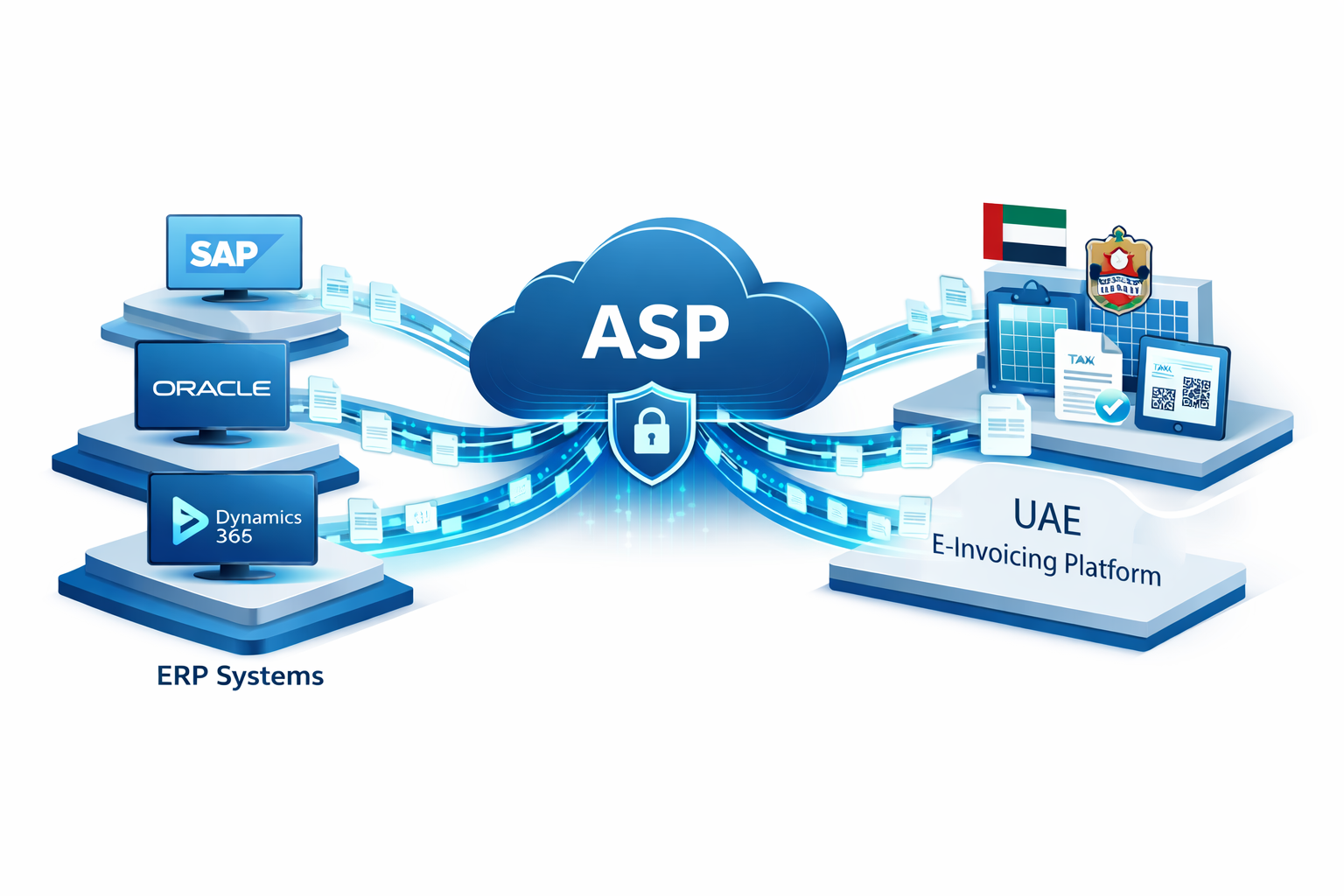
ASPs solve this problem by acting as the bridge between internal financial systems and external tax platforms.
An Accredited Service Provider functions as a middleware platform between a company’s ERP system and the national e-invoicing infrastructure.
Instead of connecting ERP systems directly to government platforms, companies transmit invoice data to the ASP. The provider then performs all required compliance and communication tasks.
This architecture allows businesses to keep their ERP processes largely unchanged while ensuring that invoices meet regulatory requirements.
The ASP typically handles several key technical processes.
A typical integration scenario between an ERP system and an ASP platform follows a structured workflow.
The process begins when a company generates an invoice within its ERP or financial system. The invoice contains all relevant transactional data, including supplier and buyer details, VAT information, product lines, and payment terms.
At this stage, the invoice is usually created in a format specific to the ERP system.
Once the invoice is created, the ERP system sends the invoice data to the Accredited Service Provider through an integration interface. This connection may use APIs, secure file transfer, or integration middleware depending on the company’s architecture.
The ASP verifies that the invoice meets regulatory requirements defined by the tax authority. This validation process typically includes checking:
If errors are detected, the system may return the invoice to the ERP for correction.
Most e-invoicing systems require invoices to follow a standardized digital format such as XML or another structured data schema.
The ASP converts the ERP invoice data into the required format, ensuring compatibility with the national e-invoicing network.
After validation and transformation, the ASP transmits the invoice through the official e-invoicing infrastructure. Depending on the architecture of the UAE system, invoices may be exchanged through certified providers, platforms, or government gateways.
The buyer receives the invoice through their own ASP or connected platform. Because the invoice is already validated and standardized, it can be automatically processed within the buyer’s financial system.
Companies can integrate their ERP environments with ASP platforms in several ways depending on system complexity and transaction volume.
Many modern ASP platforms provide APIs that allow ERP systems to send invoice data in real time. This approach is commonly used for high-volume transactions or automated invoicing processes.
Some organizations use enterprise integration tools or middleware platforms that connect ERP systems with external services. In this scenario, the middleware handles communication with the ASP.
For smaller systems, invoices may be exported from ERP platforms as structured files that are automatically transmitted to the ASP platform.
The best integration method typically depends on the company’s existing IT architecture and operational requirements.
A major advantage of working with an Accredited Service Provider is the ability to integrate with a wide range of enterprise platforms.
Most ASP solutions support integration with commonly used systems such as:
By providing standardized integration connectors, ASP platforms allow organizations to adapt their invoicing processes without major ERP redesign.
Using an Accredited Service Provider for ERP integration offers several operational advantages.
First, it reduces the complexity of regulatory compliance. Instead of continuously updating ERP systems to match regulatory changes, companies rely on the ASP platform to maintain compliance.
Second, it enables automation of invoice processing. Structured invoice data can be automatically validated, transmitted, and received, reducing manual processing and errors.
Third, ASP platforms improve scalability. As invoice volumes grow, companies can process transactions through the ASP infrastructure without redesigning their internal systems.
Finally, centralized integration simplifies multi-country compliance. Many ASP platforms support e-invoicing requirements across multiple jurisdictions, allowing companies to manage global compliance from a single solution.
As the UAE continues developing its e-invoicing framework, companies should start evaluating their ERP readiness. This includes reviewing invoice data structures, integration capabilities, and compliance requirements.
Working with an experienced Accredited Service Provider can significantly accelerate this process. ASP platforms offer integration expertise, regulatory knowledge, and scalable infrastructure that help organizations transition smoothly to compliant electronic invoicing.
For businesses operating in complex ERP environments, the right integration strategy will be essential to ensuring a successful implementation of UAE e-invoicing.
The upcoming e-invoicing framework in the United Arab Emirates will require businesses to exchange invoices in a structured, digital format that...
As governments around the world move toward digital tax reporting, the United Arab Emirates is preparing to introduce a nationwide e-invoicing...
In the meat industry, time is not only money, but above all freshness and availability of the product. Gobarto S.A., one of the undisputed leaders of...